Showing posts with label meat production. Show all posts

Friday, June 4, 2021

Satay and Processed Lamb Meat anytime!

Some of our people can enjoy these dishes only during Eid al-Adha. Of course this must continue to be improved because the average meat consumption of the Indonesian population is still low. Even though protein is one of the essential nutrients we really need. And for that lamb meat is the best meat despite many myths that oppose it. In Al Qur'an Surah 6: 143-144, eight pairs of animals (4 pairs) are two (a pair) of sheep, a pair of goats, a pair of camels and a pair of cows. Of the series of livestock mentioned in the verses above, sheep are first mentioned, then goats, camels and cattle.

Eating satay and processed lamb meat products is delicious, so how delicious if you can eat it often.The rules in the Qur'an, the first one has virtue over afterwards. Now, this is where sheep have superiority compared to other livestock mentioned in the verses, although all these animals are halal meat eaten. Other indications of the virtue of sheep can also be found in the Qurban event, namely when Prophet Ibrahim was ordered by Allah SWT to slaughter his son Ismail, then by Allah SWT saved Ismail and replaced him with a large sheep. Then we commemorate this event every year and become the Shari'a of Qurban on the Eid al-Adha feast every year in 10 Dzulhijah. Besides that, all Prophets are sheep shepherd, is another indication that lamb is the best meat and the sheep that are grazed are the best treasures.

The next question that can arise is is there another guide more specific about diet, especially protein? The Qur'an also indicates the source of protein from large livestock occupies the largest portion of poultry and fish. The source of animal protein that is from large livestock is revealed in at least 7 verses or 64%, from fish revealed in 3 verses or 27% and from poultry revealed in 1 verse or 9%. So that the fulfillment of protein needs is the priority of large livestock, especially those that are grazed, because in addition to producing cheap protein, it also fertilizes the land for various human needs. 

So that satay and processed lamb meat can be eaten anytime and anywhere, food innovation is needed. We are certainly familiar with various canned foods so that they can last longer such as gudeg, rendang and so on. Of course this is also very possible for lamb. It is also to further promote the best meat, so that when it is called meat, the community will later associate it to lamb instead of beef or chicken as happened today. If the conditions are like that, then the sheep farming industry will grow rapidly. Sheep farming can be integrated with various large plantations and for more details can be read here.

Gliricidia Leaf Feed Pellets Factory to Optimize Biomass / Energy Plantations and Increase National Meat Production

The availability of feed is very important to support and sustain the livestock business. Easy, abundant and cheap feed is important to be pursued. Feed is also the highest cost component in livestock farming, as is fertilizer for a number of plantations and farms. The effort to get a continuous supply of quality feed is an absolute prerequisite for the success of a livestock business. The supply of domestic meat, which is still mostly imported, is certainly not encouraging. For this reason, the national meat production program to self-sufficiency in meat must be encouraged. The scarcity of meat availability, which has driven higher prices, makes it easy for cheap haram meat to enter the market, especially since there is weak supervision and light sanctions for suppliers of this haram meat. As a country with the largest Muslim majority and meat is an important food element in the form of protein, the development of animal husbandry must also be in sync with these conditions. Farms that are made and become the main priority are livestock that support the halal industry. 

Gliricidia leaves, which are waste from energy  or biomass plantations, are a potential source of high nutritious food. The increasing projection of energy or biomass plantation development should also be in line with the utilization of the leaf waste for animal feed. The content of gliricidia leaves which are rich in protein is an important source of nutrition for livestock, especially ruminants such as sheep, goats and cows, so that it needs to be developed and utilized optimally. By utilizing these leaves, all parts of the tree from the energy or biomass plantations can be optimized. Making pellets from these leaves (feed pellets) will also facilitate storage, save transportation, last longer and make it easier to use as animal feed.

Muslims who carry out the Qurban worship every year will need a large supply of livestock in the form of sheep, goats and cows. In addition, during Ramadan and Eid al-Fitr, there is also a surge in demand for this meat, and it is often found that haram meat such as pork and dog is mixed with the meat above. And when a child is born, a Muslim family is also required to do aqiqah by slaughtering 1 or 2 sheep or goats. Apart from that, basically the supply of meat for daily needs is still minus. These things should be the motivation for the development of a livestock business.

Friday, May 28, 2021

Integration of Farm with Biomass Plantation or Energy Plantation

The long and expensive social costs for the production of hardwoods such as teak which require a minimum of 15 years make Perhutani company replace them with fast-rotating plants such as gliricidia. As for private companies, the main reason for growing fast-rotation species is mainly profit. Commodities that provide quick returns, with minimal risk. Short harvest time of wood which is only around 2-3 years and can be repetitive (coppice) repeatedly without the need to replanting is the advantage of these plants. Planting and caring for the tree is also very easy. The price of wood that is only worth the waste wood or firewood also mitigates the social cost of securing wood theft. The use of wood as a source of biomass or raw materials in the wood processing industry such as the manufacture of particle boards or as an energy source for example by processing it into wood pellets and wood briquettes. Hundreds of thousands of hectares have been planned for the planting and will take several years to come.

In addition to the main product namely wood, there are actually two products from the tree that can be utilized namely flowers and leaves (whole tree utilization). Flowers for beekeeping or production of honey and leaves for animal feed or meat production. Sheep, goat and cattle farms can be developed close to the plantation so that they are close to feed sources. Although the protein content in gliricidia leaves ranges from 18-24% or high enough for animal feed in general, so it is very good for animal feed, because concentrated feed usually only contains about 15% protein, but to get a balanced feed is still needed a number of other nutrients . Other complementary nutritional needs can be obtained from the surrounding community by collaborating through community empowerment. Nutrients needed for animal feed to become complete feed are complete sources of fiber, sources of protein, vitamins and minerals. Gliricidia leaves with 18-24% protein content as a source of protein, while grass or straw as a source of fiber and added vitamins and minerals.

Grazing
To produce superior livestock products, livestock grazing is the solution. With grazing, livestock will be healthier and feed costs can be cheaper because grass can be directly obtained. With an area of biomass or energy plantations that reaches tens to hundreds of thousands hectares, then allocating several tens or hundred hectares is certainly not difficult. The area can be used for pasture herds. Certain grasses can be planted as a source of food in the pasture. Sheep and cattle can even be farmed and herded in the same pasture field. Rotational grazing is a shepherding technique that can be applied because it is more effective and efficient than conventional grazing.

Single Grazing
 
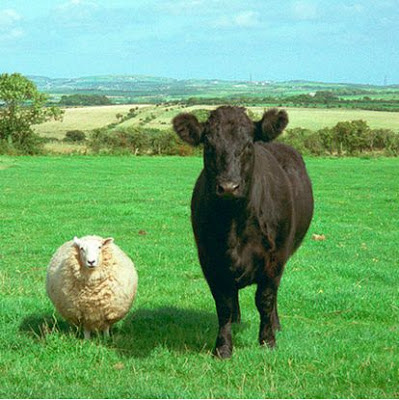
Mixed Grazing

Feed Factory
With the composition of gliricidia leaves produced from each tree reaching around 30% and an average of 10,000 trees per hectare planted, the number of leaves produced from biomass or energy plantations is huge and excessive for consumption on farms. Then it also has the potential to create animal feed factory. The livestock feed produced can then supply feed to a number of farms in various regions so that the livestock business is growing and self-sufficiency in meat is easily achieved. Meat imports that reach tens or even hundreds of thousands tons should be avoided and sufficient from domestic livestock businesses.

The main problems of livestock are feed and markets. When the feed problem has been resolved it means 50% of the problem has been solved. As for starting a business, the first thing to note is the market or the buyer. If the products produced from the business that we do have no market or buyer, then the business will lose money and go out of business. The potential lack of meat in the country can become a large market potential and export market. Regarding sheep and goats, In Indonesia indeed a number of regions prefer goats such as Jakarta, Central Java and East Java while other regions prefer sheep like Yogyakarta. This should also be a concern regarding the target market.

Unlike Honeybees, Why Does the Development of Energy Plantations Get Little Attention from the Goat/Sheep and Cattle Livestock Industry?

Along with the global decarbonization trend, energy plantations are increasingly developing in Indonesia. The creation of these energy pla...